There's a set of projections making the rounds in retail media conversations right now - and they're easy to either panic about or dismiss entirely. Early industry modelling does suggest that product impression volumes will drop significantly as AI agents start handling more of the digital shopping journey. The consumer who used to scroll through forty search results across multiple tabs will increasingly hand that job to a machine. The agent will surface three recommendations, and the scrolling stops.
But both the panic and the dismissal miss the point. The drop in impressions isn't the real story. The real story is what happens to the impressions that survive - and what they're worth when they get there.
Why the "Retail Media Is Dead" Narrative Gets It Wrong
The framing you hear at conferences and in analyst reports goes like this: if AI agents handle comparison shopping and execute purchases through APIs, the human never sees a product page, a sponsored listing, or a banner ad. Click-through rates stop mattering. Conversion funnels disappear. A $100 billion industry growing at 25%+ a year collapses overnight.
It's a clean story. It's also built on a flawed assumption - that all shopping behavior works the same way.
Full automation - where the AI handles a purchase start to finish with no real human input - applies to a pretty specific slice of commerce: commoditized, low-involvement products. Batteries. Trash bags. Basic cleaning supplies. Early research suggests these make up roughly 15 to 20% of e-commerce transactions. AI taking over replenishment of these items doesn't change much for brand strategy, because brand differentiation was already thin and consumers weren't deeply engaged to begin with.
The other 80 to 85% of purchases - electronics, fashion, health and beauty, home furnishings, food and beverage with real brand variation - work differently. For these categories, the AI acts as a filter, not a decision-maker. It narrows forty options down to three or four. The consumer still makes the final choice. The purchase is informed, not delegated.
Fewer Impressions, Higher Value
Here's where the economics get interesting - and where the opportunity actually lives.
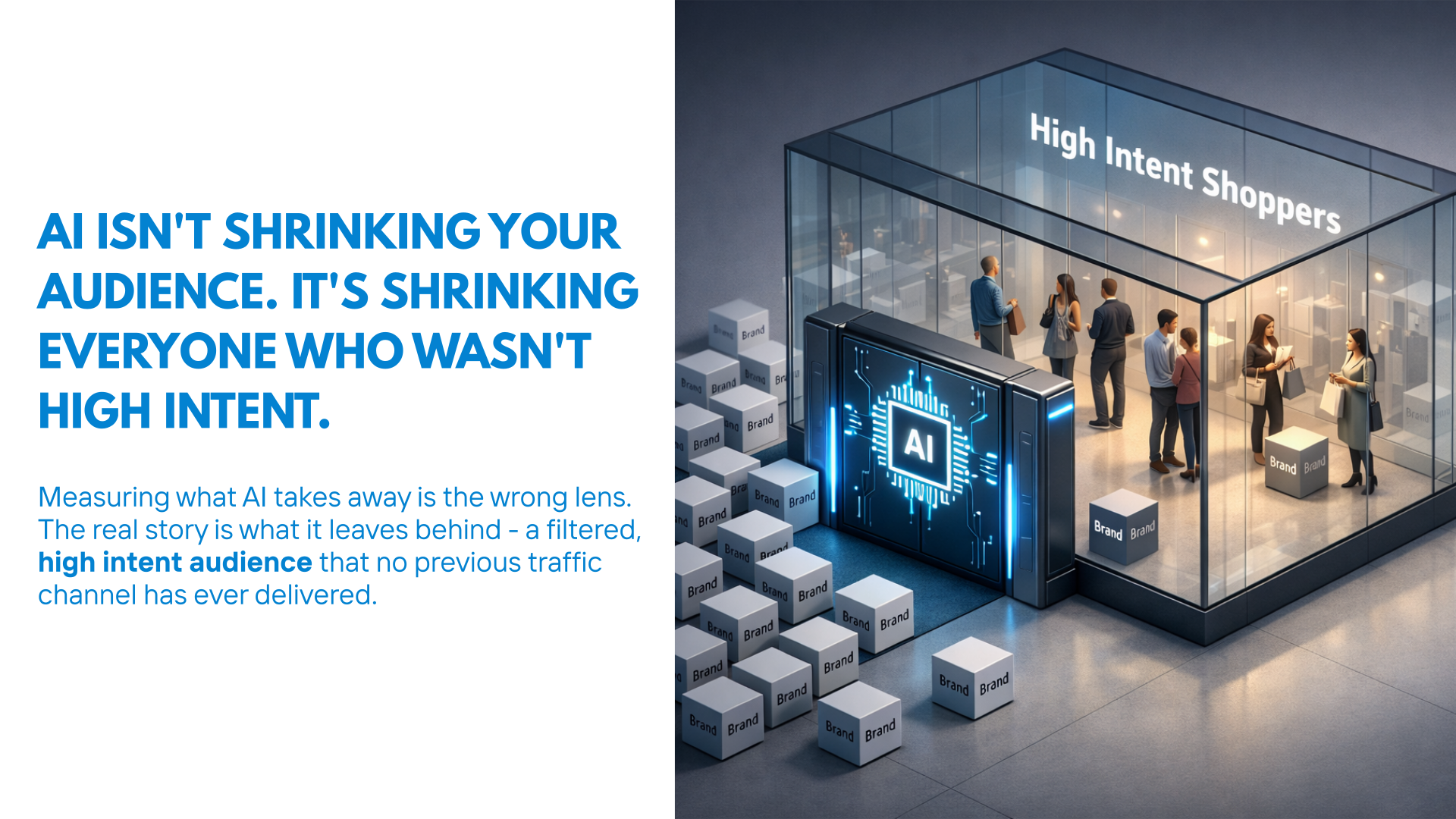
When an AI agent cuts a product result set from forty to three, it's already done the qualification work that advertising has been trying to do at scale for years. Every impression that makes it through the agent's recommendation logic represents a consumer who has already passed thresholds on price, availability, review quality, and relevance — before they ever see your product. The comparison is done. The consideration window is open. The only question left is which one they pick.
An 80% drop in impression volume combined with a massive jump in intent per impression isn't a loss. It's a structural upgrade in how traffic economics work. Waste goes down. Qualification goes up. And every remaining impression carries more commercial weight than any sponsored search placement ever has.
The brands that understand this will stop chasing reach. They'll start optimizing for selection - and those are fundamentally different games.
From SEO to AIO: The Biggest Shift in Two Decades
For twenty years, digital commerce has run on one principle: get found. SEO, paid search, sponsored listings - all of it was built to put products in front of human eyes at the moment of intent.
AI-mediated commerce flips that completely. The question is no longer whether a consumer can find your product. It's whether the AI recommends it. And the things that determine whether an AI recommends you are very different from what made you rank well in search.
AI agents don't care about marketing copy or emotional brand messaging. They parse structured data. They look at machine-readable product specs, review recency, verified purchase ratios, and real-time inventory availability. If your catalog doesn't have precise schema markup and live inventory feeds, you don't rank poorly in this world - you don't exist in it.
This is the shift from a discoverability problem to a selection eligibility problem. And it demands a completely different response.
AIO readiness comes down to four layers:
Data structure. Is your product catalog machine-readable with attributes an AI agent can parse, compare, and rank? If the data isn't structured for machines, you're invisible to them.
Review integrity. Are your reviews recent, specific, and verified? AI agents treat review recency and verified purchase ratios as primary trust signals. Old or generic reviews get filtered out.
Logistics readiness. Is your real-time inventory and fulfillment data accessible via API? Stock availability and shipping speed aren't just operational details anymore - they're active inputs in the recommendation decision.
Price competitiveness. Is your pricing dynamically competitive at the exact moment an agent runs a query? AI agents compare in real time. Static pricing strategies are at a structural disadvantage.
Brands that score well across all four don't just show up in recommendation sets. They become the default - compounding their advantage with every query cycle as the agent's logic keeps reinforcing their eligibility.
The Timeline Is Shorter Than It Feels
Treating AI-mediated commerce as a future problem is itself a strategic decision - just not one most organizations are making deliberately.
In MediaAmp's view, 2026 is the experimentation window - the period when you can build the architecture without the pressure of a crisis. By 2027, the gap between brands with AI-inclusion-ready infrastructure and those without starts hardening into a structural advantage that gets progressively harder to close. By 2028, inclusion readiness is on track to become a core business metric sitting alongside ROAS, market share, and revenue growth.
The window is real. It's also finite.
MediaAmp's POV
The Strategic Directive
The transition to AI-mediated commerce isn't a threat to defend against. It's a higher-quality traffic channel to capture. Three parallel workstreams define what that looks like:
First - build direct API partnerships with emerging AI commerce platforms. Real-time inventory syncs, structured product attribute feeds, and verified review pipelines are the inputs that determine whether your products enter consideration sets at all. These aren't marketing extras. They're the new demand capture infrastructure - the equivalent of securing prime shelf space before it gets contested.
Second - evolve your content strategy into a dual-layer model. Brand storytelling, editorial guides, and discovery content still matter for demand creation in traditional channels. But they need to be paired with dense, attribute-specific structured data that satisfies what AI recommendation logic actually looks for. These aren't competing investments - they serve different surfaces in a media environment that now operates across both.
Third - start measuring AI inclusion rate alongside traditional metrics. How often your SKUs show up in agent-curated recommendation sets is a distinct and increasingly important signal - one that impression and click-through tracking was never built to capture. Brands that track both will see the traffic shift for what it is: not a decline, but a migration toward higher-intent, higher-value exposure.
The Advisory Audit
Most brands assume they're ready for AI-mediated commerce because their current performance dashboards look stable. But being visible in search results and being eligible for AI recommendation sets are two very different things. The traffic that matters most over the next three years won't come from impressions - it will come from selections.
At MediaAmp, we evaluate whether your data architecture, measurement framework, and capital allocation are positioned to capture the highest-intent traffic channel in digital commerce - or whether they're optimized for a model that's compressing. This isn't a technical SEO review. It's an assessment of whether your infrastructure qualifies you for inclusion where intent density is highest. If you want to understand where you stand, reach out to our team - we'll help you work through it.
The Resilience Factor
Consider a realistic scenario: traditional search traffic drops meaningfully within 18 months as AI agents capture a growing share of high-intent commerce queries. Recommendation sets narrow to three or four options per category. Each of those positions now carries dramatically more purchase intent than a traditional search impression.
Brands with established API partnerships, structured attribute feeds, and real-time inventory syncs won't just stay visible. They'll occupy the positions where intent density is highest - and compound that advantage with every query cycle.
Brands without that architecture won't just lose ranking. They'll be absent from the consideration set entirely - locked out of the most valuable traffic channel digital commerce has ever produced.
Resilience isn't something you build during a crisis. It's something you build before one. Our Black Swan Playbook is designed to help brands build that architecture now - so when AI-mediated commerce scales, your products aren't just visible. They're chosen.
Related Articles
Continue exploring with these hand-picked articles on similar topics