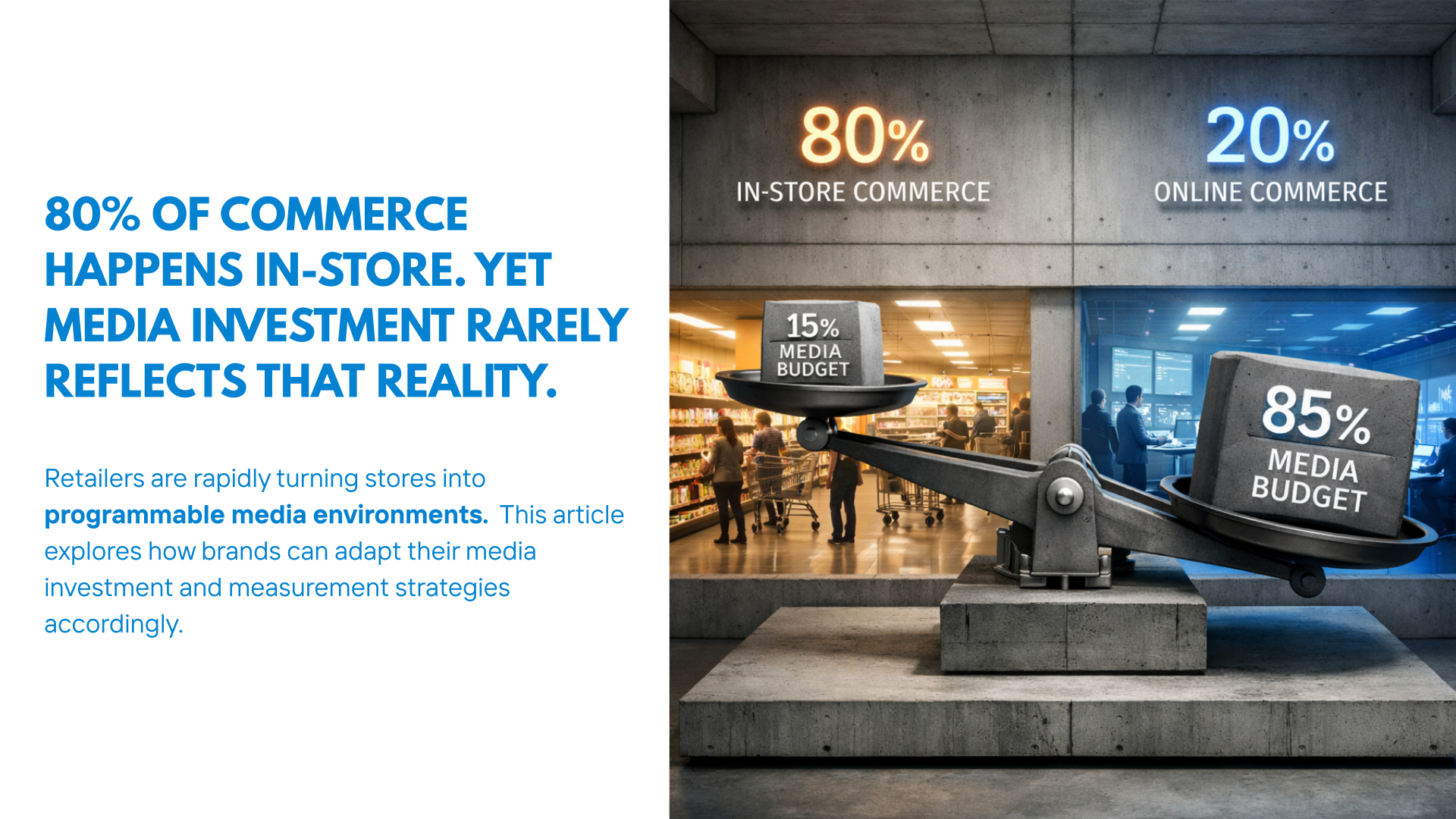
Four out of every five retail transactions still happen inside a physical store. That number gets cited a lot - but the capital allocation reality behind it is worth pausing on. About 85% of retail media spend flows into digital channels: sponsored search, onsite display, programmatic placements. The environment where 80% of purchases actually happen is treated by most brand organizations as unmeasurable, untrackable, and not worth a serious media conversation.
This isn't a small gap. It's a systematic misallocation of capital sitting right at the center of how retail media strategy gets built - and the infrastructure excuse that used to justify it no longer holds up.
The Organizational Split That Created the Problem
The budget structure most brands operate with today reflects a divide that made sense a decade ago but has quietly turned into a liability.
On one side you have retail media - digital, dashboard-driven, ROAS-optimized - owned by media teams and measured in platform analytics. On the other side you have shopper marketing - trade-funded, category-managed, tied to printed signage and end-cap displays - run by sales teams with different budgets and different goals.
This split has survived not because it produces better results, but because it fits neatly into how organizations are already structured. Digital media is easy to attribute. Physical media historically wasn't. So budget flows to where the dashboard lights up - and the store gets treated as a distribution problem rather than a media opportunity.
What's changed isn't the logic. It's the reality underneath it. The infrastructure that made in-store media genuinely unmeasurable has been replaced by systems that produce rigorous, standardized, independently verifiable measurement. The organizational divide has outlasted the conditions that justified it.
The Audience Nobody Is Fully Reaching
Before getting into measurement, it's worth understanding the sheer scale of what's being left on the table.
Walmart's global store fleet handles roughly 270 million customer visits per week. Kroger's in-store audience runs at about 2.7 times its digital footprint - around 41 million in-store visitors versus roughly 15 million digital, when you factor in dwell time and purchase proximity. These aren't niche audiences. They're the single largest addressable group in commerce.
And the physical environment has changed dramatically. Three infrastructure layers have turned what used to be a static merchandising space into a programmable, addressable media surface - one that can be bought with the same sophistication as digital inventory.
Digital end-caps have replaced static cardboard displays with dynamic screens that rotate content based on time of day, inventory levels, and loyalty signals from shoppers physically in the aisle.
Smart cooler doors use transparent LCD screens on refrigerator units to serve video and display ads while capturing dwell-time and interaction data. Cooler Screens alone now reaches close to 100 million viewers monthly across roughly 10,000 screens at major grocery and pharmacy chains.
Checkout-lane screens reach a captive audience at the highest-intent moment in the entire shopping trip - making them one of the most commercially valuable media surfaces in any retail environment.
A single store now operates as hundreds of discrete, targetable microchannels. Screens in the baby care aisle can serve diaper promotions on Tuesday mornings because loyalty data shows that's when the relevant shoppers show up most. This isn't broadcast advertising squeezed into a physical space. It's programmatic, closed-loop, audience-targeted media that can be planned and bought alongside CTV and mobile in a unified strategy.
The Measurement Excuse Is Gone
The argument that held in-store media back for a decade - that you can't measure physical retail with the same rigor as digital - has been answered at the industry level.
The IAB has standardized a two-pillar measurement framework for in-store retail media:
Pillar One - Opportunity to See (OTS). Traffic counters and sensor infrastructure now produce an in-store equivalent of the digital impression - a verified signal that a shopper was physically exposed to a media placement.
Pillar Two - Closed-Loop Sales Lift. Purchase data from stores running active media gets compared against matched control stores without it. This isolates the incremental revenue generated by in-store activations with the same statistical confidence applied to digital campaigns.
Early deployments across major grocery networks have shown double-digit incremental sales lift in exposed stores versus controls. Attribution is clean. Incrementality is measurable. And because the infrastructure cost is mostly front-loaded, in-store digital inventory runs at near-pure margin for retailers - which means the supply side has every reason to scale it fast.
The barrier is no longer measurement. It's organizational. The budget structures, team setups, and KPI frameworks inside most brands were built for the old split between digital performance media and trade-funded shopper marketing. They haven't been updated for the world that actually exists now.
MediaAmp's POV
The Strategic Directive: Five Moves to Close the Gap
Fixing the 80/20 imbalance isn't about tweaking channel plans. It's structural. These five moves define what the shift looks like in practice:
1. Put budget governance under a single commerce media authority. The core problem right now is that in-store digital inventory competes for trade marketing dollars against static cardboard displays. As long as that's true, programmable, measurable media surfaces will be chronically underfunded. Move in-store digital into a unified commerce media budget - one team with authority across physical and digital touchpoints, evaluated against a shared incrementality standard. You don't have to dismantle trade marketing. You just have to stop funding addressable media from a budget designed for static merchandising.
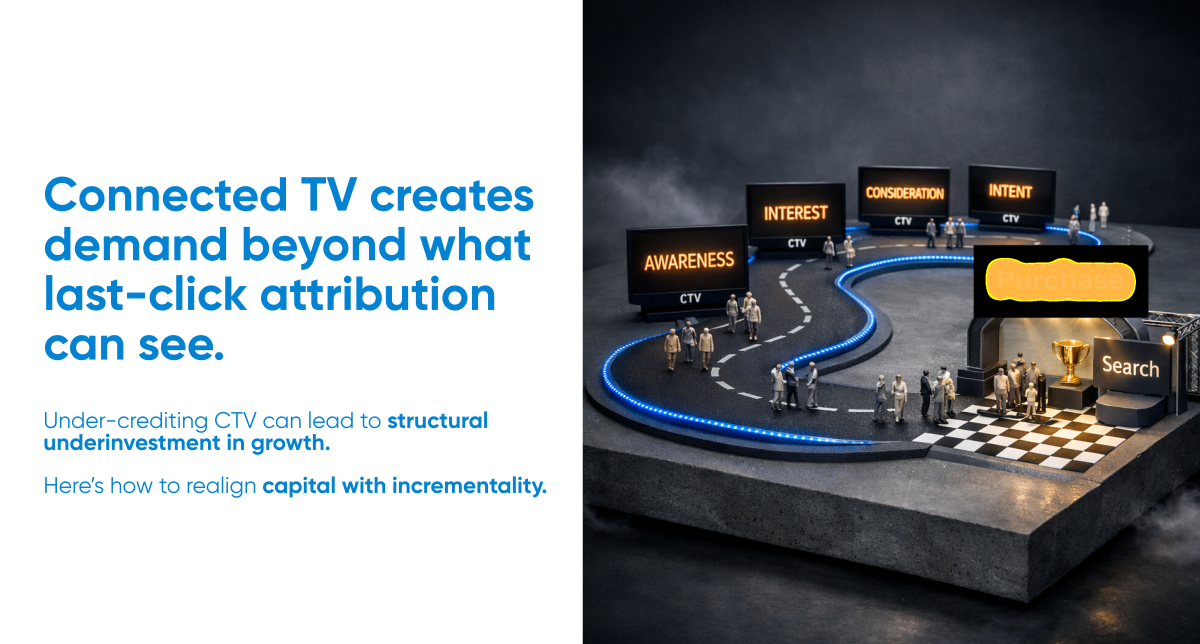
2. Build a three-screen sequential messaging architecture. The modern path to purchase flows across three programmable surfaces: the living room (CTV for awareness), the pocket (mobile for reinforcement), and the aisle (in-store screens for conversion at the moment of truth). Design campaigns that orchestrate messaging across all three instead of running each in isolation - the compounding effect is something no single-channel strategy can match.
3. Demand IAB-compliant measurement at every physical touchpoint. The frameworks exist and they're standardized. Brands should expect OTS verification and closed-loop sales lift reporting as standard from in-store media partners. Where that measurement layer isn't available, your budget decisions should reflect the reduced visibility - don't fill the gap with assumptions.
4. Reclassify in-store digital as addressable inventory, not "shopper marketing." This sounds like a language change, but language drives budget decisions more than most organizations realize. When programmable in-store screens are evaluated as addressable media, they compete on commercial terms with onsite display and CTV. When they're categorized as trade activity, they get buried in a separate budget with entirely different success metrics.
5. Establish unified KPIs across physical and digital surfaces. A search ad and a cooler-door activation are doing related commercial work and should be measured against comparable incrementality metrics. The industry is moving toward a single standard - incremental ROAS or incremental sales lift - applied consistently across every commerce media touchpoint regardless of where it physically sits.
The brands that move early on this get access to the biggest audience arbitrage in retail media: massive in-store scale at CPMs well below what saturated digital channels are charging. That pricing gap closes as retailers recognize the margin economics and scale supply. The timing advantage is real - and it's measured in years, not decades.
The Advisory Audit
Most brands evaluate in-store and digital retail media through separate budgets, separate teams, and separate measurement frameworks - not because that structure works best, but because it's inherited.
If your in-store digital activations are still funded from trade marketing budgets and planned independently of your programmatic and onsite retail media, your capital allocation is probably disconnected from where 80% of your transactions actually happen.
At MediaAMP, we assess whether your commerce media architecture operates as a unified system - or whether organizational fragmentation is quietly suppressing the returns available from the largest addressable audience in retail. If you want to evaluate whether your current structure is set up for the opportunity that actually exists now, reach out to our team — we're ready to help you work through it.
The Resilience Factor
Consider a realistic disruption: a major retail partner launches unified in-store and digital inventory through a single buying platform — collapsing onsite search, display, and physical screen placements into one interface.
Brands without consolidated budget governance will stall at internal alignment. Which team owns the buy? Which budget funds it? Which KPI framework evaluates a campaign that spans a cooler-door screen and an onsite banner?
Competitors with a single commerce media owner and unified KPIs will activate immediately - locking in early pricing, preferred inventory, and the learning curve that compounds over time.
Resilience isn't something you build during disruption. It's something you build before it. Our Black Swan Playbook is designed to help brands build exactly that - so when the physical-digital convergence accelerates, your organization adapts instead of deliberates.
Related Articles
Continue exploring with these hand-picked articles on similar topics