The Strategic Readout: Escaping the Gig Economy Trap
For years, Instacart has lived in the toughest corner of the digital economy — the on-demand delivery battlefield — where logistics are expensive, margins are razor-thin, and competitors like DoorDash and Uber Eats burn billions chasing speed.
This model works for volume, not for profit. Every delivery fulfilled is a cost center.
Instacart’s pivot acknowledges a simple truth:
The path to profitability isn’t faster delivery — it’s smarter enablement.
The Profit Engine Behind the Pivot
- Instacart Ads — a growing retail media network monetizing shopper intent across grocery and now new verticals.
- The Instacart Platform — a white-label suite offering enterprise tech, analytics, and e-commerce infrastructure to retailers.
Both are high-margin businesses — the kind that investors assign SaaS and ad-tech multiples to, not delivery-service valuations.
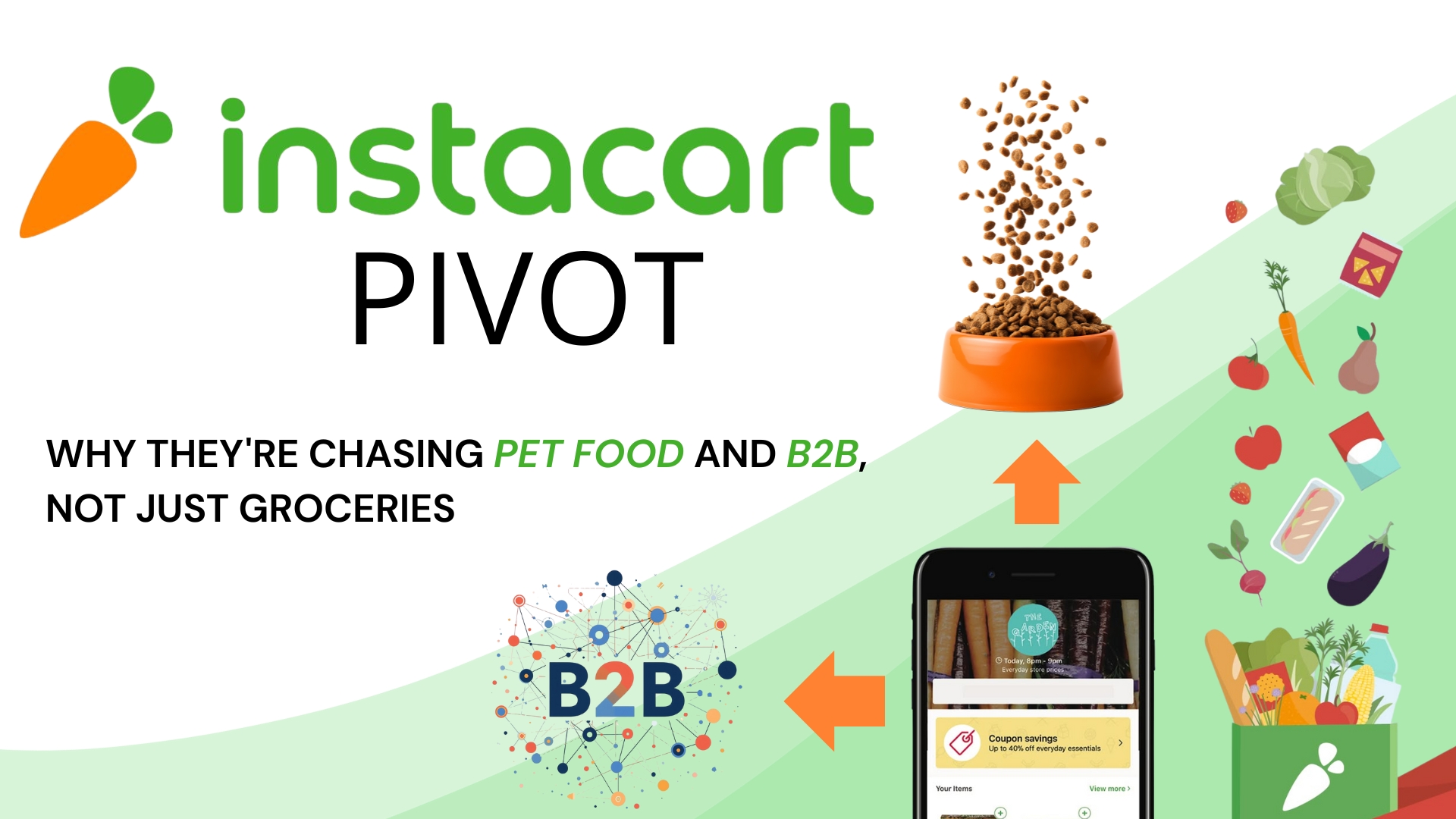
By expanding into categories like pet supplies and wholesale foodservice, Instacart isn’t diversifying delivery; it’s expanding its TAM (Total Addressable Market) for Ads and Platform clients.
Every new retailer onboarded brings:
- More ad inventory.
- More first-party shopper data.
- More enterprise tech adoption.
The result: exponential, not incremental, growth.
The Operational Blueprint: How Instacart Is Re-Architecting Retail
Instacart’s expansion playbook follows a clear logic: Use delivery as a Trojan Horse — the visible service that hides the real product: infrastructure.
1. Pet Supplies Plus: Entering the Loyalty-Heavy, High-Frequency Vertical
Pet food is an ideal category: habitual, replenishment-based, and data-rich. This partnership opens 700+ stores, allowing Instacart to:
- Extend retail media targeting into the $136B U.S. pet market.
- Create new cross-category advertising opportunities (e.g., pet food + cleaning products).
- Onboard a retailer segment that has high repeat purchase behavior and measurable ad attribution potential.
2. Restaurant Depot: The B2B Expansion
The B2B play is arguably more transformative. Wholesale delivery means bulk orders, predictable patterns, and enterprise clients. More importantly, it embeds Instacart’s technology into foodservice operations — creating new use cases for The Instacart Platform and Ads in a space largely untouched by consumer delivery players.
Together, these two deals redefine Instacart’s purpose:
From “on-demand groceries” to “multi-vertical retail infrastructure.”
The Financial Logic: From Logistics to Licensing
Wall Street doesn’t reward hustle; it rewards high-margin scalability.
The strategic pivot to advertising and SaaS reframes Instacart’s valuation model:
| Old Model | New Model |
|---|---|
| Labor-heavy, delivery-first | Software-led, enablement-first |
| Low-margin, competitive | High-margin, defensible |
| Growth via expansion | Growth via platform adoption |
| Valued like DoorDash | Valued like Shopify or The Trade Desk |
By positioning itself as a “Shopify for Grocers”, Instacart is sending a message to investors:
“We’re not a delivery company. We’re a retail operating system.”
And that narrative shift is worth billions in market cap.
The MediaAMP POV: The Retail Operating System Era
At MediaAMP, we see Instacart’s transformation as part of a broader structural realignment in commerce. The next decade will belong to platforms that provide data, infrastructure, and monetization capabilities — not just logistics.
Instacart’s play mirrors a trend we’ve seen across the ecosystem:
- Amazon evolved from e-commerce to cloud (AWS).
- DoorDash is building merchant services and advertising.
- Walmart Connect and Roundel are becoming software-led media platforms.
Instacart’s competitive advantage? It’s already embedded inside thousands of retailer workflows. Turning that embeddedness into software subscriptions and ad revenue is not a pivot — it’s a monetization unlock.
The Implications for Brands: The New Frontiers of Retail Media
For brand marketers, this shift expands the retail media battlefield dramatically.
- New Categories: Ads can now reach high-intent buyers in pet care, home goods, and B2B channels.
- Cross-Vertical Data: Shopper insights now span grocery, pets, and wholesale — creating more powerful targeting models.
- Performance Marketing at Scale: The ability to reach professional buyers (via Restaurant Depot) brings new performance use cases for CPG and foodservice brands alike.
Instacart Ads is becoming a multi-vertical commerce media engine, not a grocery niche.
The Bottom Line
Instacart’s recent moves aren’t about adding delivery partners. They’re about redefining what Instacart is.
The company is using its delivery footprint as a strategic Trojan Horse — a low-margin entry point to capture high-margin relationships. Its true ambition is to become the default operating layer for modern retail — from grocery to pet food to wholesale.
The message is clear:
The gig economy may have built Instacart’s scale, but retail enablement will build its future.
Related Articles
Continue exploring with these hand-picked articles on similar topics