There's a number that keeps showing up when brands run independent measurement against their Connected TV investments - and it tends to catch people off guard. The dashboard said 2.8x ROAS. The controlled study said 6.4x. Same campaign. Same creative. Same time period. The difference wasn't performance - it was how performance was being measured.
That gap isn't a rounding error. It's a sign that the measurement framework being used was built for the wrong job - and for brands making budget decisions based on last-click dashboards, it's quietly compounding into misallocation at a scale that doesn't show up until real damage is done.
Why CTV Keeps Losing Budget Conversations It Shouldn't Be Losing
Put a retail search campaign and a CTV campaign side by side in a standard performance dashboard and the comparison looks obvious. Search delivers 7 to 9x ROAS, clear click-through data, and deterministic attribution. CTV shows $35 to $45 CPMs, very few immediate clicks, and a last-click return somewhere around 2 to 3x.
Under the logic most performance frameworks use, the budget decision makes itself. But this comparison only works if both channels are doing the same thing. They're not.
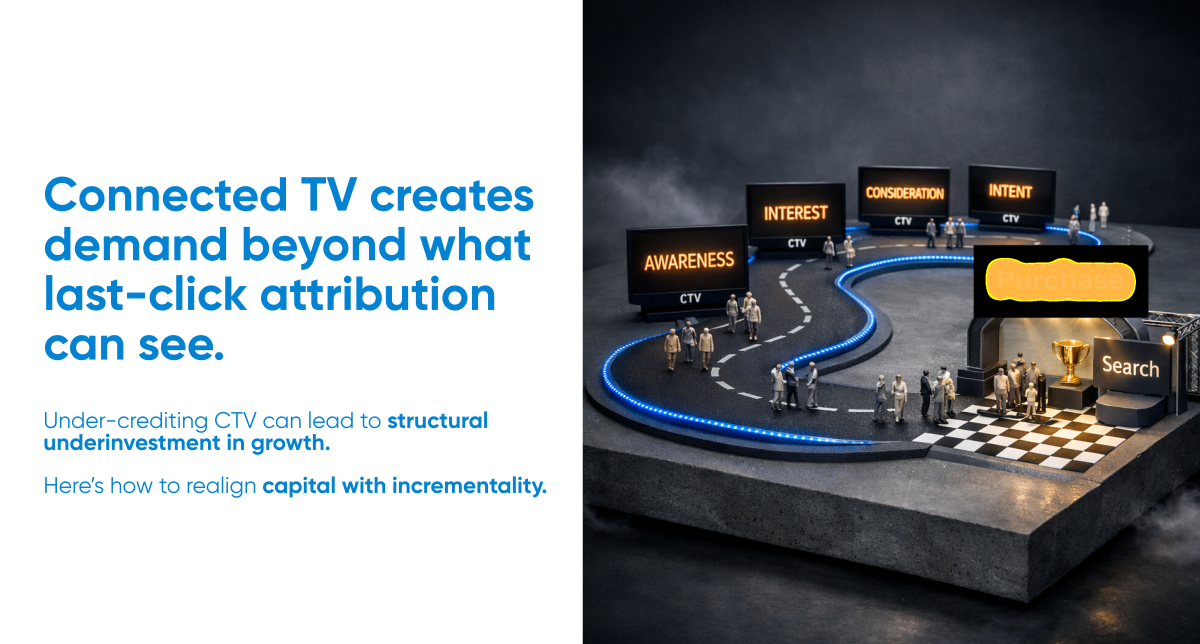
Search is a demand capture channel. It picks up people who already know what they want and are actively looking for it. CTV is a demand creation channel. It builds awareness and interest upstream - it's the reason someone eventually types a brand name into a search bar or picks up a product in-store days later.
Measuring these two channels with the same last-click model is like judging a farmer and a grocer by the same metric and deciding the farmer is underperforming because he doesn't sell directly to customers.
Or to put it even more simply: search is standing at the finish line claiming credit for the race. CTV is the one actually running it.
The 95% That Standard Measurement Doesn't See
The real problem with CTV measurement becomes clear when you look at what last-click tracking actually captures. Only about 5% of CTV-driven conversions show up as immediate clicks - the only thing conventional attribution sees clearly. The other 95% converts through paths that last-click models either miss or credit to something else entirely: brand searches days after someone saw an ad, in-store purchases from people who watched a spot on their TV, retargeting conversions from audiences that CTV put into the funnel in the first place.
A campaign being judged on 5% of what it actually does isn't being measured. It's being sampled from a tiny sliver - and penalized for everything that sliver can't see.
The scale of this gap shows up clearly in controlled tests. In one DMA study, search ROAS in markets without CTV exposure was 7.1x. In markets where CTV had been running, search ROAS jumped to 9.2x - a clear halo effect that standard attribution would give full credit to search. The CTV dashboard showed 2.8x. The real incremental blended return was 6.4x.
In a separate beverage case, the last-click figure was 3.1x against a true incremental ROAS of 5.8x - 87% more value than any dashboard in the organization was reporting.
This isn't tactical noise. It's a structural blind spot.
What Happens When You Systematically Under-Credit Demand Creation
The downstream effects of last-click bias are predictable - they just take long enough to show up that the cause isn't always obvious when the damage becomes visible.
Budget gravitates toward the channels that generate the most measurable credit. Over time, demand capture channels eat up a bigger and bigger share of media investment. Demand creation channels - the ones feeding the intent that capture depends on - get slowly starved. Search auctions get more expensive as brands pile into the same space chasing the same existing intent, with less upstream demand being created to replace it. The efficiency curve on search flips. And somewhere down the line, revenue growth flatlines in a way that's hard to diagnose - because every individual channel dashboard still looks fine.
This is the fork in the road that matters.
Path A: You keep measuring CTV through last-click frameworks. Dashboards look strong. Everyone feels confident. But 12 months later, total business revenue is flat or declining. You've become very efficient at harvesting existing demand - but you've turned off the engine that creates new demand.
Path B: You measure for incrementality. Individual channel metrics might look less impressive, because credit is no longer piled onto the last click. But 12 months later, total revenue is up 8 to 15% - because CTV is constantly feeding fresh, interested customers into every other channel in your portfolio.
For years, performance marketing has trained teams to obsess over the last click. It's easy to measure and easy to optimize. But that obsession is systematically starving the channels that do the hard, upfront work of building a brand and creating tomorrow's customers.
MediaAmp's POV
The Strategic Directive
Brands need to fix their measurement architecture before they fix their media mix. The answer isn't "optimize CTV better." It's to build incrementality discipline into how you operate.
That takes three structural shifts:
Separate creation from capture. Demand creation channels like CTV need to be evaluated on incremental lift - not last-click efficiency. Search and CTV shouldn't be competing inside the same attribution model. They do different jobs.
Make controlled testing standard practice. Geo-holdout tests, ghost-ad controls, exposed-versus-control market analysis - these can't be occasional experiments you run to defend a budget decision. They need to be how you routinely measure. If incrementality isn't being tracked consistently, budget will always default toward whatever looks best on a dashboard - not what's actually causing growth.
Align finance with causal metrics. Performance reporting should clearly separate two types of revenue: captured revenue (demand that already existed) and created revenue (demand your media actually generated). Without this distinction, organizations end up optimizing short-term optics at the expense of long-term growth - and nobody has the language to call it out.
These shifts work best with a three-layer measurement stack:
Layer 1 - Direct Attribution. Keep tracking immediate clicks and conversions. But treat this as the absolute floor of CTV's value, not the ceiling.
Layer 2 - Incrementality Testing. This is the north star. Forget who got the last click. Answer one question: did my ads cause sales that wouldn't have happened otherwise?
Layer 3 - Brand Lift Surveys. Measure how CTV is moving the needle on awareness, consideration, and purchase intent over the long term.
Structural leverage gets rebuilt when brands control their own measurement - not when they optimize inside the attribution windows that platform dashboards set for them.
The Advisory Audit
Most brands evaluate Connected TV using last-click dashboards that were never designed to measure demand creation. If your budget decisions rely mainly on attributed ROAS, you may be reinforcing attribution bias rather than measuring real incremental growth.
At MediaAMP, we assess whether your measurement architecture operates independently of the platforms selling the media - and whether it properly separates demand capture from demand creation to show you what's actually driving lift. If you want to evaluate whether your current approach is building structural leverage or reinforcing platform dependency, reach out to our team - we're here to help you test the system behind your numbers.
The Resilience Factor
Consider a realistic disruption scenario: retail search CPCs jump 25% due to auction pressure. Attribution windows compress. Finance mandates ROAS targets that favor last-click efficiency.
Brands that have deprioritized demand creation will watch search efficiency decline with no upstream engine to stabilize performance. Brands that have built incrementality discipline into their operations will keep growing - because they understand which investments create demand, not just capture it.
Resilience isn't something you build during a crisis. It's something you build before one. Our Black Swan Playbook is designed to help brands build exactly that - so when disruption hits, your strategy adapts instead of collapses.
Related Articles
Continue exploring with these hand-picked articles on similar topics