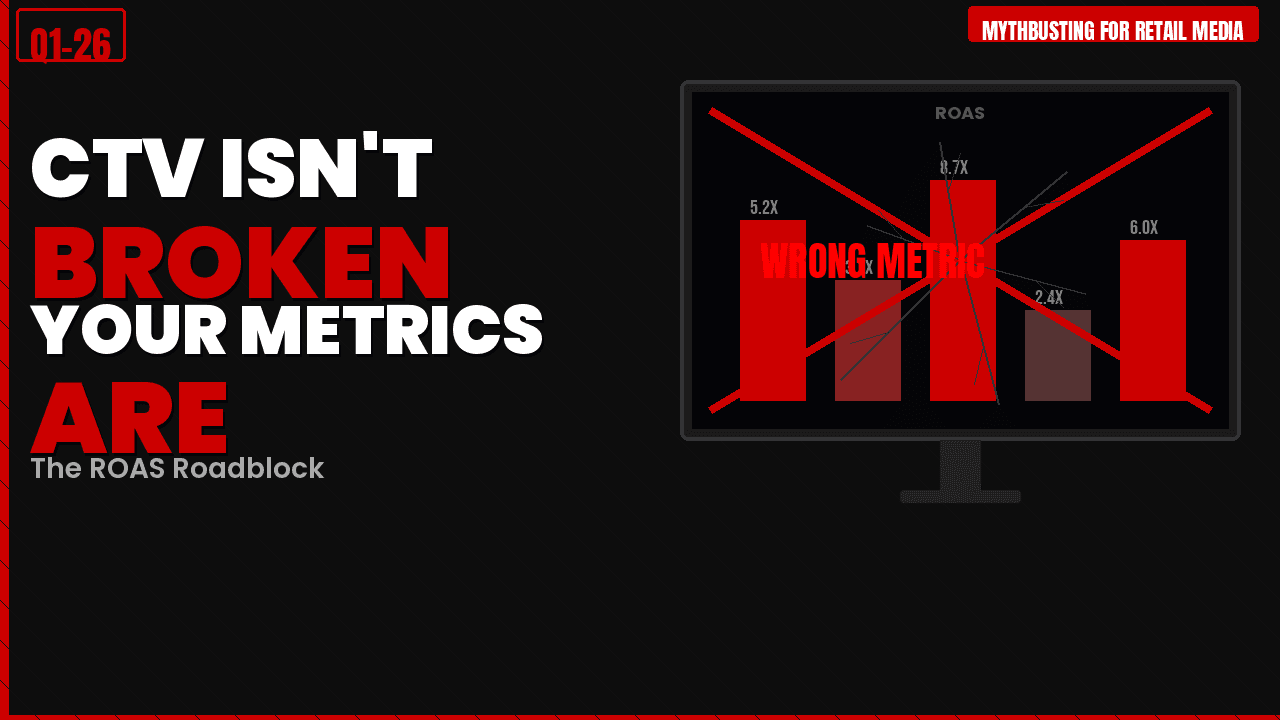
CTV Isn't Broken - Your Measurement Is
Explore why judging Connected TV campaigns by last-click metrics misses the vast majority of CTV's value, and how a new measurement playbook focusing on incrementality and brand lift can drive real business growth.
Watch the Full Episode
Dive deep into the insights and discover what really drives growth
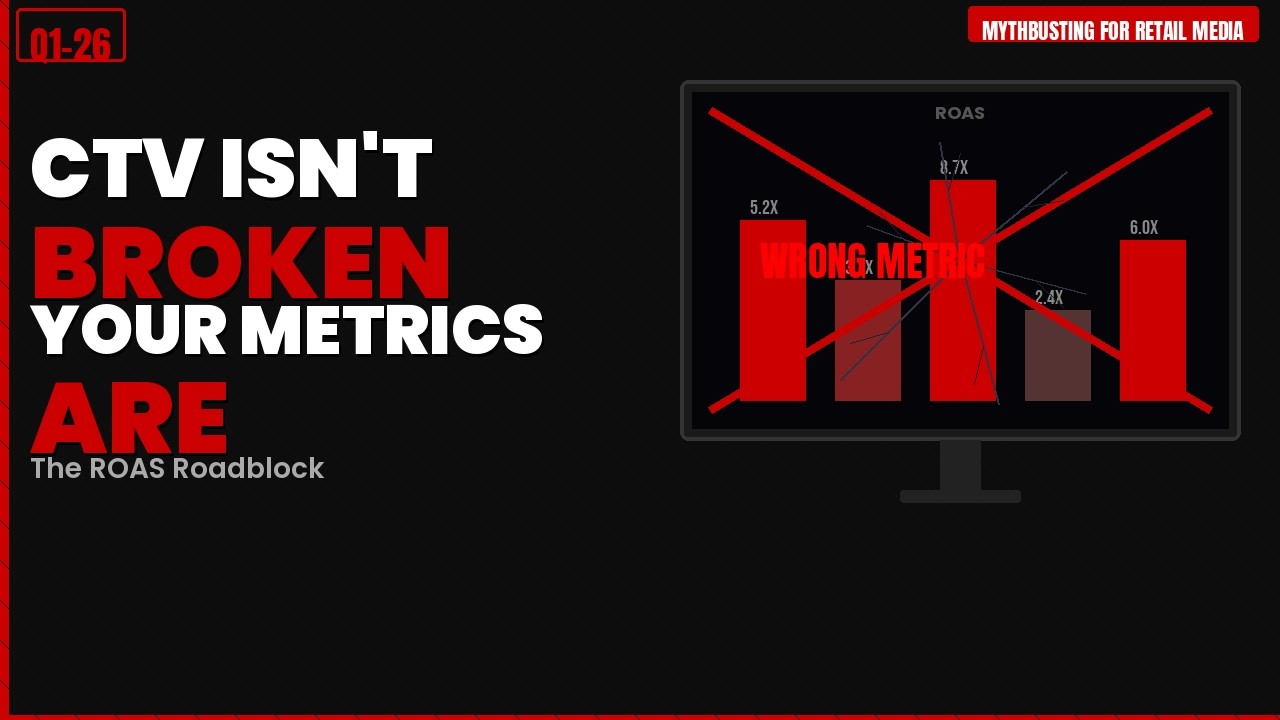
CTV Isn't Broken - Your Measurement Is
Explore why judging Connected TV campaigns by last-click metrics misses the vast majority of CTV's value, and how a new measurement playbook focusing on incrementality and brand lift can drive real business growth.
Everything You Need to Know
Go beyond the video with detailed insights, actionable takeaways, and expert analysis.
Executive Summary
In this episode of the Mythbusting Series, we dive into what may be the most costly measurement mistake brands make with Connected TV (CTV): relying on last-click metrics and surface-level dashboards to judge performance. While traditional reporting shows low clicks, high CPMs, and poor direct ROAS, these figures only capture about 5% of the true impact CTV provides. CTV doesn't just capture demand — it creates it, generating incremental searches, physical purchases, and brand consideration that traditional dashboards fail to capture.
Why CTV Looks Broken (But Isn't)
Many brands run Connected TV tests and draw the wrong conclusion: high CPMs, low click-through rates, and modest last-click ROAS suggest that CTV is inefficient compared to search. On the surface, this looks like a smart, data-driven decision. But this conclusion is based on an incomplete measurement model that only captures about 5% of CTV's real contribution — the tiny slice of the audience who click immediately.
What is entirely ignored are the other 95% of outcomes: consumers who later search for the brand, end up buying in person, or shift into active consideration.
Search Captures Demand — CTV Creates It
The traditional comparison between search and CTV is fundamentally flawed. Search captures demand after it exists — users have already decided to look. CTV, on the other hand, creates demand — initiating the journey that leads to search, consideration, and purchase. This essential difference makes last-click ROAS an ineffective indicator of CTV's value.
A controlled experiment with a major CPG brand shows that markets with CTV ads saw search ROAS jump from 7.1x to 9.2x — a halo effect invisible on surface dashboards. Additionally, true incremental ROAS for CTV, when measured properly, reached 6.4x — more than double what the last-click report suggested.
The Three-Layer Measurement Stack
To capture CTV's deeper value, brands need a new measurement framework:
- Layer 1 — Direct Attribution: Still includes direct attribution, but treated as the floor, not the ceiling.
- Layer 2 — Incrementality Testing: The most critical layer — evaluates whether sales would not have happened without the CTV exposure.
- Layer 3 — Brand Lift Studies: Quantifies awareness and consideration over time.
These layers together expose the true causal impact of CTV and enable smarter optimization.
Two Strategic Paths
Brands face a choice: the status quo of optimizing channels based on last-click dashboards — which leads to flat or declining growth — or embracing a measurement approach that recognizes causality and total business contribution, driving revenue increases of 8–15% over 12 months.
The Bottom Line
Relying on traditional last-click metrics to judge Connected TV performance obscures most of its real value and leads to flawed decisions. A measurement approach that emphasizes incrementality and brand lift reveals CTV's true influence on search, purchases, and consideration, and enables sustained business growth.
"Traditional dashboards capture only about 5% of CTV's true performance. The other 95% goes unseen — until you fix the measurement."
Key Takeaways
Traditional dashboards capture only about 5% of CTV's true performance; the other 95% goes unseen
CTV doesn't just respond to demand — it creates it, initiating search and purchase behavior downstream
Controlled experiments show that CTV improves performance in other channels (e.g., search ROAS)
The three-layer measurement stack (direct attribution, incrementality, brand lift) captures true impact
Optimizing for last click alone starves demand generation and limits overall growth
Brands that embrace scalable measurement and causality see long-term revenue gains and stronger multi-channel performance
Continue Your Learning Journey
Explore more myth-busting series and uncover the truths that drive sustainable growth

Beyond the 5-Year Lookback: Why Incrementality and Category Growth Drive Real Marketing Impact
Discover why extended historical data windows risk over-emphasizing the past at the expense of what truly matters today: incrementality, category dynamics, and forward-looking growth levers.

Beyond PDP Optimization: Why Price-Pack Architecture is the Real Growth Lever
Discover why no amount of SEO copywriting or keyword targeting can fix a fundamental issue: selling the wrong pack at the wrong price. Learn how Price-Pack Architecture drives both category growth and brand profitability.

Category Momentum > Last-Click Sales
Discover why retail media budgets allocated based on last-click attribution are reactive and starve emerging opportunities. Learn how Category Momentum drives proactive growth strategy.

Creative is the Bottleneck and AI is the Unlock
Discover why the true bottleneck for retail media performance isn't algorithms or budgets, it's creative relevance. Learn how AI enables faster, cheaper, and more adaptive creative pipelines.